
Japan’s parcel-delivery market is entering a new stage. E-commerce continues to grow, logistics providers are under pressure to reduce repeat deliveries, and parcel boxes—known locally as 宅配ボックス (takuhai box)—are becoming part of the country’s delivery infrastructure.
For importers, home-centre buyers, housing suppliers and private-label brands, the opportunity is not simply to offer a large metal box. Products must fit Japanese homes, installation practices, delivery routines and expectations for an orderly entrance area.
Why Japan’s parcel-box demand remains important
Japan’s Ministry of Economy, Trade and Industry reported that the domestic B2C e-commerce market reached ¥26.1 trillion in 2024, an increase of 5.1% year on year. The merchandise segment alone reached ¥15.2 trillion. Continued online purchasing means more parcels must be received when residents are not at home.
At the same time, Japan’s Ministry of Land, Infrastructure, Transport and Tourism reported a parcel redelivery rate of approximately 8.4% in April 2025. This was lower than the October 2022 comparison figure, but repeat delivery remains a material burden in a market facing driver shortages and tighter logistics capacity.
Japan’s 2026 logistics policy also sets a goal of increasing the use of diverse receipt methods—including parcel boxes and unattended delivery—from 25.6% in February 2025 to approximately 50% by fiscal 2030. This gives housing and distribution channels a clear reason to keep expanding practical delivery-box options.
Delivery rules are supporting parcel-box use
Japan Post states that where a parcel box or lockable container is installed, certain deliveries can be left there when the recipient is absent, subject to service conditions and exclusions. Since July 2024, advance application is no longer required for eligible Yu-Pack deliveries to parcel boxes and other designated secure locations.
For product buyers, this means the parcel box must be easy for delivery personnel to recognise and operate. A complicated delivery process can reduce real-world use even when the product itself is secure.
Installation flexibility is a core Japanese requirement
Japan does not have one universal residential installation format. Current products in the market are offered across several configurations:
- Wall-mounted (壁付け): suited to compact entrance areas and renovation projects.
- Freestanding (据え置き): useful when wall integration is not practical.
- Pole-mounted (ポール): supports detached homes with limited wall space.
- Wall-embedded (壁埋め込み): provides a clean, integrated appearance for new construction.
- Gatepost or entrance-unit integration (門柱ユニット): combines delivery, mail and entrance functions.
In 2025, Japanese manufacturer Nasta expanded its detached-house range to cover five installation styles. Its cited survey data showed parcel-box installation at 31.1% for detached houses, compared with 62.0% for apartment buildings. Although this is manufacturer research rather than a national census, it highlights a practical gap in the detached-house market.
Selected parcel-box configurations for Japan


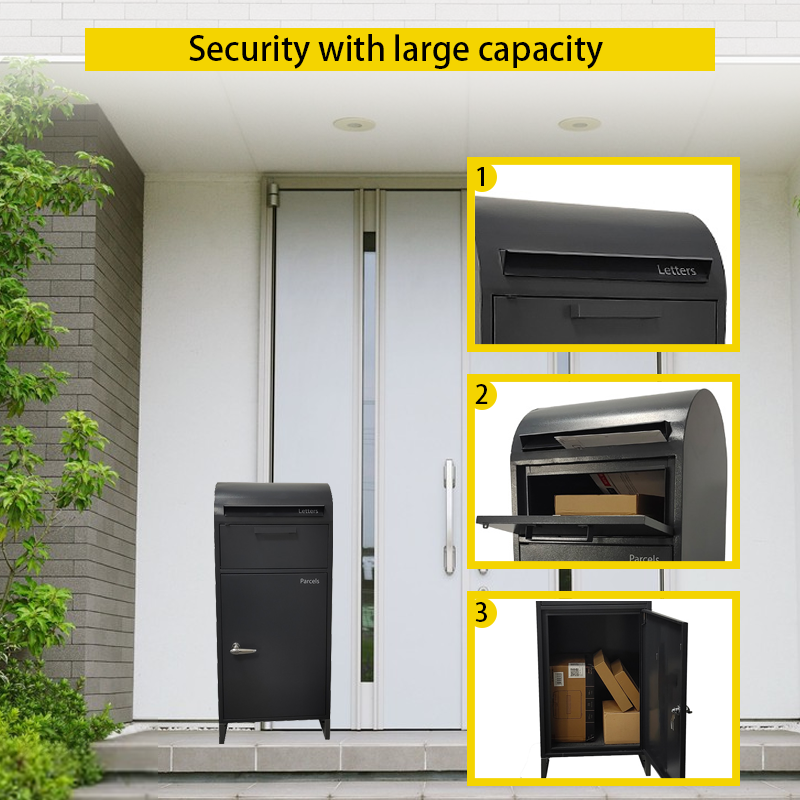


Selected configurations for Japan-focused OEM and private-label projects. Specifications are available on request.
What B2B buyers should specify
1. Match capacity to the target channel
A larger box is not automatically better. Buyers should define common parcel dimensions, entrance-space constraints and whether the product is intended for new housing, renovation, home centres or online retail.
2. Make delivery operation obvious
The courier-facing door, operating instructions and locked status should be understandable at a glance. Japanese-language labels and visual instructions can reduce delivery errors.
3. Offer installation options
A platform that can support wall, base or pole accessories gives distributors more flexibility than a single fixed installation method. Installation drawings and hardware selection should be part of the product package.
4. Choose the lock for the application
Mechanical push-button, dial, key and electronic configurations each serve different price points and housing applications. The correct choice depends on operating simplicity, maintenance expectations and channel positioning.
5. Prioritise a clean residential appearance
Compact proportions, controlled gaps, consistent powder coating and concealed or orderly fixings are especially relevant where the parcel box sits close to the front entrance.
6. Prepare for retail and e-commerce fulfilment
For online sellers and private-label programs, packaging size, assembly logic, damage protection, Japanese instructions and replacement-part planning should be evaluated together. A flat-pack or knock-down structure may support shipping efficiency where the final assembly process remains simple and reliable.
A practical OEM development checklist
- Target customer and sales channel
- Maximum parcel dimensions
- Wall, floor, pole or integrated installation
- Front retrieval or through-wall retrieval
- Mechanical or electronic locking
- Material, coating and outdoor exposure requirements
- Japanese labels and installation instructions
- Private-label colour, logo and packaging
- Sample testing and quality-control requirements
Developing parcel boxes for Japan
WELDON works with B2B buyers on parcel-box manufacturing, product configuration and private-label requirements. The starting point should be the local use case—not simply an existing model number.
Explore our parcel box range, review wall-mounted parcel boxes and freestanding parcel boxes, or contact WELDON to discuss a Japan-focused OEM project.