
Apartment parcel delivery has become one of the most frequent complaints strata managers and body corporates handle across Australia. A single apartment tower can receive hundreds of parcels a day, and when residents are at work, couriers are left buzzing intercoms that nobody answers. Parcels pile up in foyers, cards get left behind, and the building committee ends up managing a problem that used to belong to the postal service. This guide sets out the four main solutions, what each one really costs, and how to specify a system that survives daily courier traffic for years.
Why Apartment Parcel Delivery Is Breaking Down
Three forces collided over the past decade. First, parcel volume exploded: e-commerce turned the daily mail run into a daily package run. Second, apartment living grew faster than building infrastructure — most strata buildings were designed around letter-sized mail, not 400 mm cardboard boxes. Third, courier networks reward first-attempt completion, so when a resident is not home, drivers increasingly leave parcels in foyers, stairwells or against the intercom rather than re-attempt later. The result is predictable: misplaced parcels, disputes between neighbours, and a constant stream of complaints directed at the strata committee.
The Hidden Cost of Failed Parcel Deliveries
For a building committee, failed apartment parcel delivery is not just an annoyance — it has measurable costs:
- Staff time. Building managers log, store and hand out parcels that arrive without a system.
- Liability. Parcels left in shared foyers get lost or stolen, and the building’s duty of care becomes a grey area.
- Resident churn. Delivery experience is now part of how residents rate a building — and how buyers judge it.
- Security risk. Propped-open fire doors and tailgating during parcel handovers undermine building access control.
Four Apartment Parcel Delivery Solutions Compared
| Solution | Upfront cost | Ongoing cost | Security | Best for |
|---|---|---|---|---|
| Concierge / front desk | None | High (staff hours) | Medium | Premium buildings with staffing |
| Mail room shelving | Low | Staff time | Low–Medium | Small buildings, low volume |
| Electronic parcel lockers | Very high | Service fees | High | High-density towers |
| Cluster parcel boxes | Medium | Near zero | High | Most strata buildings |
1. Concierge or front desk handover
Where a concierge is already on duty, personal handover works well — but it scales poorly. Parcels per staffed hour keep climbing, and shift gaps leave the foyer exposed.
2. Shared mail room shelving
Open shelving is the default in many buildings and the least secure option. Unattended shelving invites mix-ups and theft; camera coverage helps after the fact but does not prevent loss.
3. Electronic parcel lockers
Smart lockers from carriers and third parties offer code-based retrieval and good audit trails, and networks like parcel lockers are now familiar to most residents. The trade-offs are capital cost, per-use fees, power and connectivity requirements, and limited capacity that still overflows at peak seasons.
4. Cluster parcel boxes (the pragmatic choice)
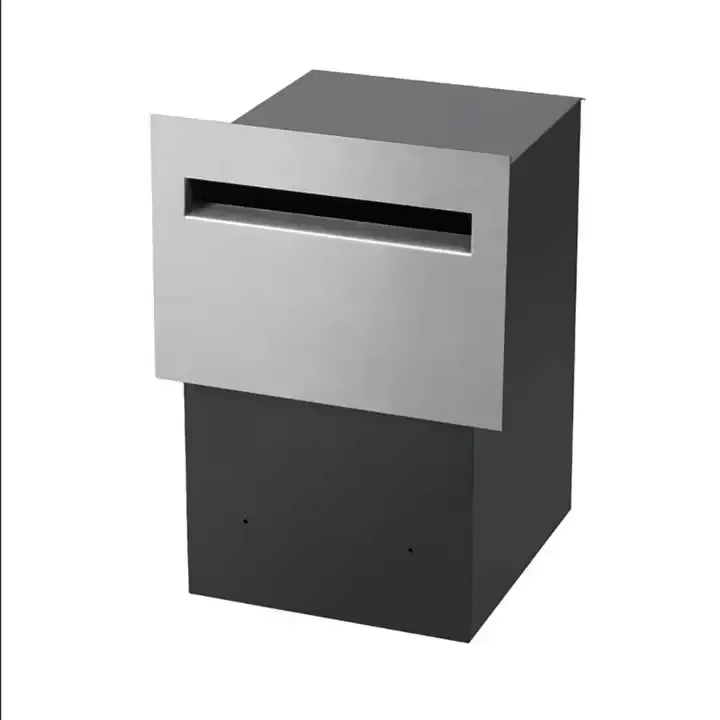
A cluster parcel box bank gives each residence a lockable compartment in a shared steel bank installed at the mail point. Couriers deposit into any available compartment and the resident retrieves with their own key — no power, no software, no per-parcel fees. For most strata budgets it delivers the best security-per-dollar of any apartment parcel delivery approach, and it scales by simply adding banks.
What to Specify When Buying Cluster Parcel Boxes
- Materials and finish. Galvanised steel with outdoor-grade powder coating; confirm salt-spray resistance for coastal buildings.
- Lock hardware. Cam locks as standard, with code-lock or smart-lock upgrades for premium projects.
- Compartment mix. A blend of letter, satchel and parcel compartments matches real delivery profiles better than uniform boxes.
- Anti-pry construction. Recessed hinges, folded edges and reinforced doors resist opportunistic attacks.
- Mounting. Freestanding plinths, wall-mounted banks or recessed installation into lobby walls and fence lines.
- Identification. Laser-cut or engraved unit numbers so residents and couriers never guess.
How WELDON Supports Strata and Developer Projects
WELDON manufactures parcel and mailbox systems from laser cutting through CNC bending, welding and powder coating at its 5,300 m² Ningbo facility, exporting to Australia, Europe and North America for two decades. For strata and developer projects this means cluster banks can be customised — compartment mix, colours, lock types and branding — at factory-direct pricing, with OEM/ODM support documented on the factory page. Residential products are available individually through the parcel box range.
Frequently Asked Questions
What is a cluster mailbox?
A cluster mailbox is a single steel bank containing individually locked compartments for multiple residences, installed at one shared delivery point. Couriers make one stop, and each resident opens only their own compartment.
Are parcel lockers free to use in Australia?
Carrier-operated lockers are generally free for residents to use, but availability is limited to specific locations and capacity fills quickly in peak season — which is why buildings install their own dedicated banks.
How many parcel compartments does an apartment building need?
A practical starting point is one parcel compartment per 5–8 residences, weighted toward the building’s observed daily volume, plus letter compartments for every unit. Buildings with high turnover or short-stay tenants should scale up.
A Quick Checklist for Strata Committees
- Count the volume. Pull average daily parcels per 100 residences from building manager logs before choosing bank sizes.
- Shortlist the location. Pick a mail point couriers can reach quickly, with lighting and CCTV coverage.
- Match the compartment mix. Survey residents on package sizes rather than guessing.
- Get specifications in writing. Steel thickness, coating and lock grades should be documented, not assumed.
- Plan the expansion. Confirm the supplier can deliver matching banks later so the installation grows with the building.
Planning a retrofit or a new build? Explore the cluster mailbox solutions, browse the residential parcel box range, or contact WELDON for a specification and quotation tailored to your building — including custom finishes and lock options for apartment parcel delivery projects.